
César Luis Menotti: The Philosopher Who Coached with His Heart
He didn’t just coach footballers, he coached human beings.

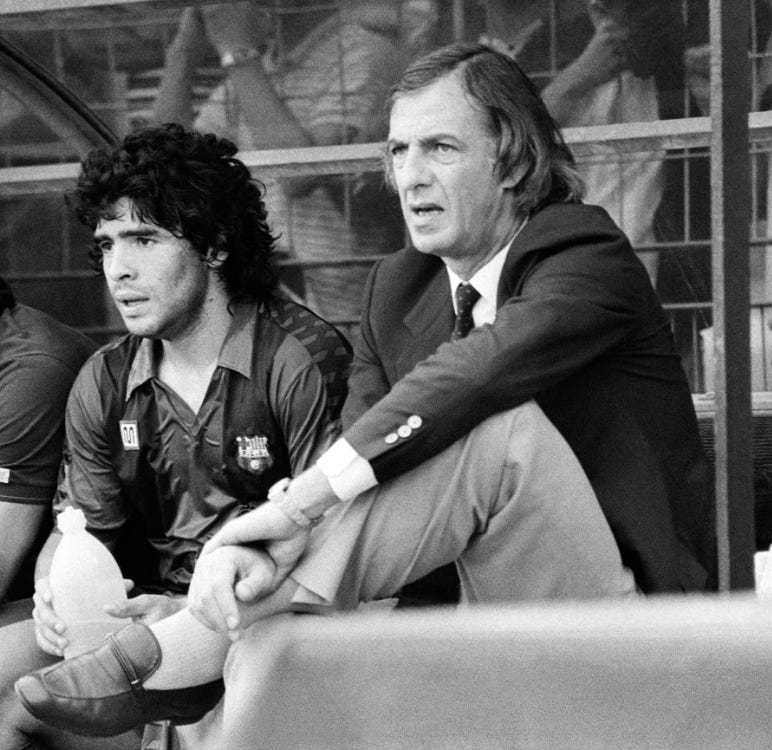
"The ball is to the player what words are to the poet: at the foot or the head, it can become a work of art."
— César Luis Menotti
In the history of football, there are coaches who mastered tactics.
There are coaches who built dynasties.
And then there is César Luis Menotti.
A cigarette in one hand. A quote from Neruda or Sartre in the other.
And a deep, unshakable belief that football should first and always be an expression of joy.
Menotti didn’t just accept mavericks, he designed his teams around them. He trusted them, protected them, and believed they could change the world. And in doing so, he shaped a footballing philosophy that still challenges the way we coach, develop, and understand genius today.
🇦🇷 A Rebel Born in Rosario
Menotti was born in 1938 in Rosario, Argentina, a city that would later produce Messi, Bielsa, and a lineage of footballing firebrands. He came of age during an era of political upheaval, cultural tension, and revolution. His mentors weren’t just coaches, they were poets, musicians, and political thinkers.
To Menotti, football was never just football.
It was a reflection of society.
Of class.
Of resistance.
"In leftist football, we don't play solely to win, but to improve, to feel joy, to experience a celebration, to grow as human beings."
— César Luis Menotti
🎨 Freedom Before Formation
When Menotti coached, he didn’t begin with diagrams. He began with questions:
What kind of world do we want this team to express?
How can we give players freedom to feel, not just execute?
His teams trained with the ball, always.
They played with improvisation, rhythm, and emotional connection.
They took risks. They expressed themselves.
"Football has given me a way to express myself."
— César Luis Menotti
👑 The World Cup, on His Terms
In 1978, Menotti led Argentina to their first-ever World Cup win.
But this wasn’t just a trophy, it was a statement.
Menotti’s team played with fluidity, daring, and imagination.
They didn’t just beat opponents. They danced past them.
Players like Mario Kempes and Leopoldo Luque were not system players, they were instincts wrapped in boots. And under Menotti, they were allowed to breathe.
This, all during a time when Argentina was under military dictatorship. While others were silent or compliant, Menotti made it clear:
"My players have defeated the dictatorship of tactics and the terror of systems."
— César Luis Menotti
👶 The Man Who Freed Maradona
No act defined Menotti’s courage more than giving 16-year-old Diego Maradona his Argentina debut.
At an age when most federations would say “too young,” Menotti said: “He’s ready.”
He believed in Maradona’s magic. He saw the maverick spark and didn’t try to contain it. He protected it.
"I maintain that a team is above all an idea, and more than an idea it is a commitment, and more than a commitment it is the clear conviction that a coach must transmit to his players to defend that idea."
— César Luis Menotti
To coach Diego was to embrace chaos, contradiction, genius, and vulnerability. And Menotti never blinked.
🧱 A Philosophy That Outlived the Scoreline
Menotti’s influence didn’t end with a World Cup or with Maradona. His legacy lived on in ideas:
In Marcelo Bielsa, with his moral demands on style.
In Guardiola, who called Menotti “a footballing father figure.”
In Fernando Diniz, Brazil’s most emotionally expressive coach today.
And in every player who was ever told: “Be yourself first. Football will follow.”
🚨 Why It Still Matters
Today, youth football is flooded with GPS units, pressing traps, and tactical conformity.
Players are taught to move before they’re taught to feel.
And coaches are trained to control before they’re trained to understand.
That’s why Menotti matters now more than ever.
"Football is so much more than a business."
He reminds us that the job of the coach is not to produce robots. It is to guide artists.
💬 Questions for Coaches
Do you value beauty even when it’s risky?
Do you allow for imperfection in service of expression?
Can your environment hold space for emotion, not just execution?
Because if not, we may be coaching the next Maradona into silence.
🖤 The Maverick’s Mentor
César Luis Menotti didn’t just win.
He didn’t just inspire.
He defended the soul of football, with a cigarette in hand, and a belief in players who didn’t fit the mold.
"In memory remain the teams that won with good play."
And for that, he remains, forever, a Maverick.
Thanks for reading, Will.
The Maverick Code: From Systems to Soul
A weekly celebration of those who played and coached the game differently, creatively, courageously, and unapologetically.
If you enjoyed this at all you’d be doing me a big favour by giving it a like and/or sharing with a friend. Cheers!
Hola, excelente artículo. Me encanta el flaco Menotti
Brilliant.