
Socrates: The Corinthians Democracy
The lost art of standing for the people.

A Goal That Stopped Time
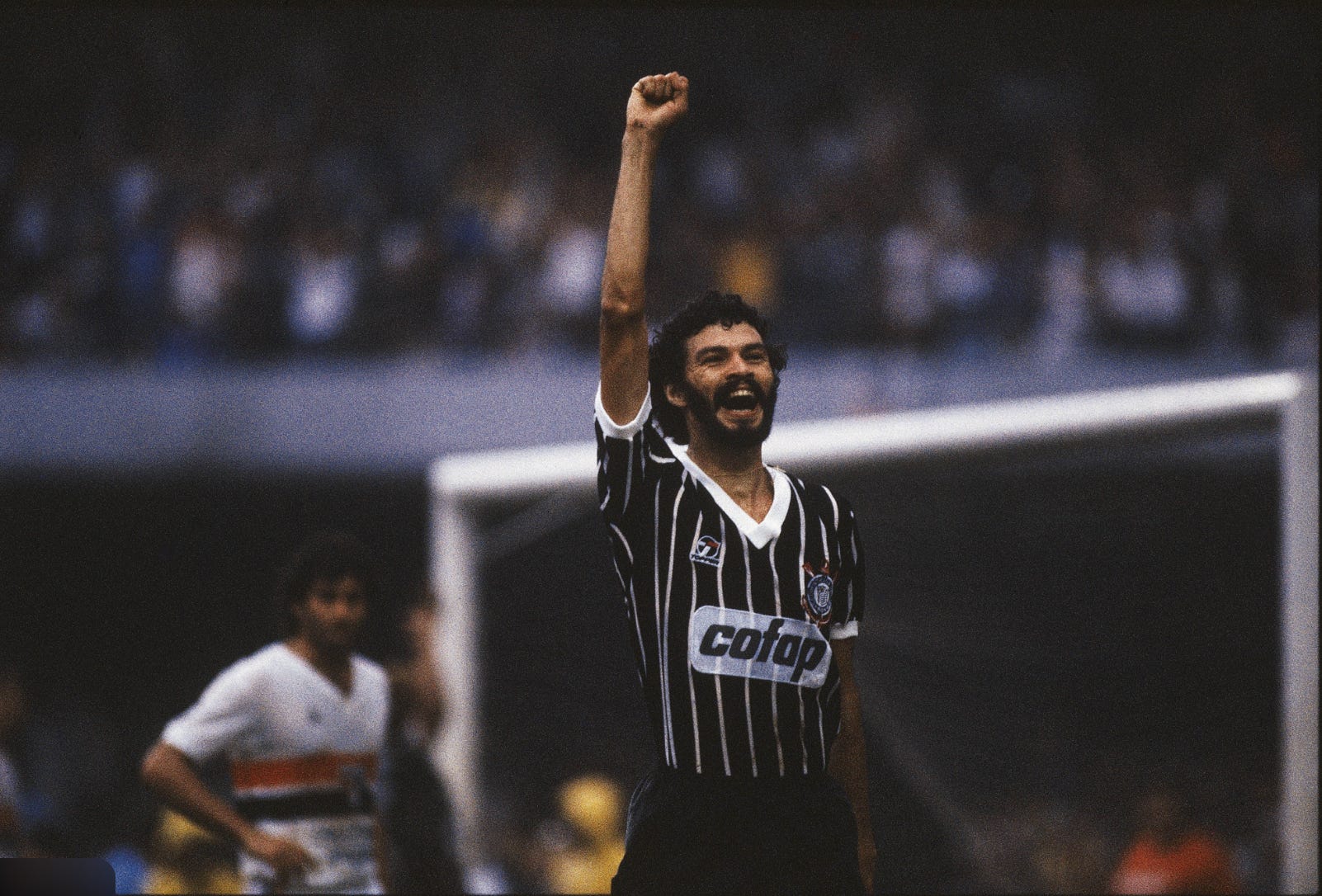
He side-stepped two Russian defenders as if they were misplaced furniture and rifled a shot with such ferocity and precision into the top corner that it felt like the world held its breath. His lanky frame, those impossibly snug shorts, and his swaying, conductor-like gait, all merged into a moment that stopped time. It was the first match of the 1982 World Cup, and the man known as “The Doctor” had just announced his presence on the global stage with something more than a goal. It was a statement. Something visceral and beautiful. Something brave.
A Ten-Year-Old Fan and the Samba Spell
I confess that at the grizzled age of ten, my political understanding of Brazil’s troubles was, shall we say, unsophisticated. From my perch on the other side of the world, just staying up late to catch the World Cup in Spain was miracle enough. But like so many others, I was completely and utterly transfixed by the Samba Boys, my second favourite team, like everyone’s second favourite team. And at the heart of them, a player who moved with music in his body and revolution in his heart: Sócrates.
Brazil in 1982 weren’t just playing football; they were playing music, painting frescoes, casting spells. It was all flicks and feints and goals that defied logic and physics. All of this arrived shortly after Zico’s Flamengo had thumped my beloved Liverpool in the Intercontinental Cup in Japan, and it was as if the gods of the game had relocated permanently to Rio. These magicians from South America, moving with swagger and playfulness, were something entirely different. Tomorrow, in our street game, we would all pretend to be them.
__________________________________________________________________________
Each week I write to support coaches and fans of the beautiful game to see beyond simply tactics and into the whole human experience that the game evokes. This is The Art of Football.
Past articles you might like:
César Luis Menotti: The Philosopher Who Coached with His Heart
He Told Me to F##k Off… So I Gave Him the Captain’s Armband
Paul Gascoigne: The Genius Who Couldn't Be Tamed
__________________________________________________________________________
A Broken Nation Clinging to Joy
And yet, behind the curtain of this footballing theatre, Brazil was in crisis. The country had suffered under the heavy hand of military dictatorship since the mid-1960s. Economic decay, rising poverty, runaway inflation, and suffocating control had turned a once-vibrant nation into something hollowed out. The people, disenfranchised and exhausted, were left clinging to whatever joy remained, 90 minutes at a time, courtesy of the national team. Their beloved seleçāo.
Sócrates knew all of this. He had lived it. Born in a small town, raised by a father who worshipped books more than goals, he earned his way through medical school while playing for Botafogo. A doctor and a footballer, two identities rarely found in one person. He read voraciously, discussed politics openly, and understood the machinery of the world in ways most footballers were never encouraged, or permitted, to grasp.
But education wasn’t what set him apart. It was awareness. Having played endlessly with local kids on dusty streets, Sócrates understood Brazil’s racial and economic chasms. He saw how football served as both escape and distraction. The game was, for the masses, an escape and return to joy. For those in power, the club owners and government officials, it was something else entirely: a tool. A balm to pacify, a lever to manipulate, a spectacle to conceal the state’s failings.
Footballers, meanwhile, were meant to be grateful. Grateful they could earn a living, grateful for the adulation, grateful to be allowed near the flame. Grateful, and silent.
“In general, players are conservative because the system is conservative. They are born into a system and are unable to break out of it. So they accept being treated like children all their life because it is comfortable for them.””
— Sócrates
Rebellion in Boots
Sócrates did not stay silent.
He was, by nature and conviction, someone unwilling to be babysat or boxed in. One of his earliest acts of defiance was questioning why players were forced to sleep in hotels the night before matches. It was a ritual rooted in control disguised as professionalism. He chafed at the idea, demanding the freedom to decide for himself. Of course, the truth nestled inside this rebellion was as flawed as it was principled, Sócrates also simply didn’t want to give up his nights out, with all the drink and company they promised. But the principle remained: footballers were adults, and they deserved autonomy.
“To play for Corinthians is to respect a culture, a people, a nation. To play for Corinthians is like being called up for an irrational war and never doubting that it’s the most important that ever existed. It is like being asked to think like arx, fight like Napoleon, pray likethe Dalai Lama, give your life to a cause like mandela, and cry like a baby.
—Socrates
When he moved to Corinthians, a storied club in the capital city, São Paulo, he saw something else. An opportunity. His star was rising, his influence broadening. The country was restless. The system was brittle. And he, surrounded by a few likeminded thinkers in the club’s staff and dressing room, began to imagine something wild: a football club that could mirror the democracy Brazil so desperately needed.
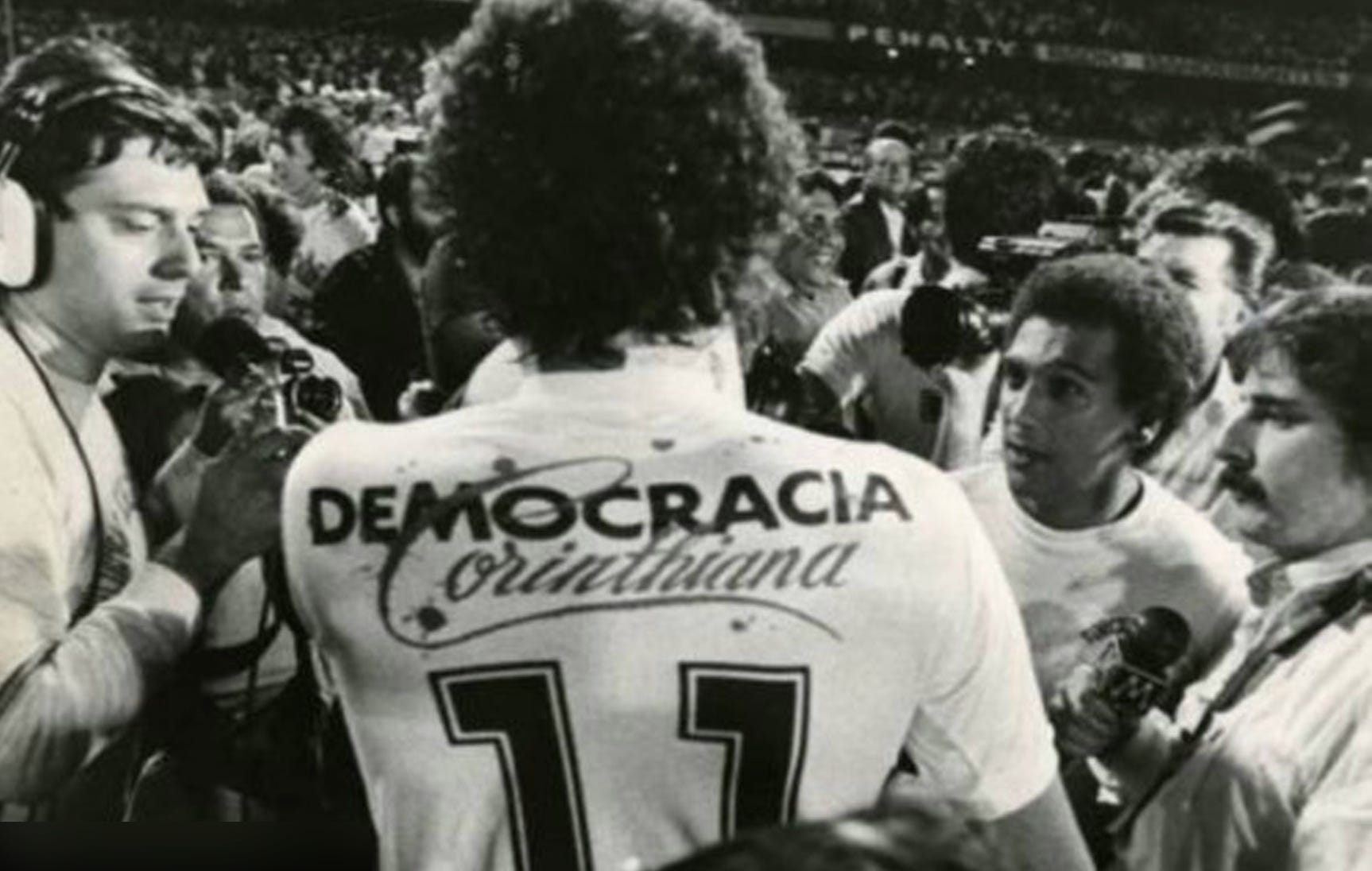
It began simply. Players were encouraged to read more, to ask questions, to have opinions. Decisions, on training schedules, signings, even travel stops, would no longer be made from above but voted on by everyone, from players to physios to kit men. Even the tea lady had a say. It was direct democracy, right there in the locker room.
They called it the Corinthians Democracy.
What appeared to be a charming experiment in team cohesion was, in truth, a political act of rebellion. The players were daring to govern themselves in a country where even citizens couldn’t vote freely. They wore shirts before matches bearing slogans like “Vote on the 15th.” They spoke out in interviews. They didn’t just entertain; they agitated.
The risk was real. The government was watching. Powerful club owners were displeased. Even within the squad, not all players were convinced. Fear lingered in the corners. This was more than a team culture shift, this was defiance in boots. But Sócrates didn’t flinch. He believed in it too deeply. He believed that if footballers could take control of their own lives, perhaps one day, the people could too.
And for a brief, shimmering moment, it worked. Brazil stirred. Marches grew. The dictatorship wobbled. People spoke of change, and in São Paulo, a football club was helping lead the charge.
“Discussing these themes in an environment such as football considerably amplifies the range of the debate. It reaches people who don’t have much information, who are less educated, because it is a working-class environment. I think that was the principal benefit of the movement, it allowed more people to discuss politics. Everyone in Brazil understands football. Not everyone understands politics because the majority aren’t educated enough. But if you put both things together you can educate lots of people and provoke transformations in society.”
— Sócrates
A Glorious Year, a Sudden Fall
1982 should have been the year of crowning. Corinthians lifted the Paulista championship, ending a long drought. Sócrates, resplendent in form and philosophy, captained the national team at the World Cup and lit up the world with a kind of football that felt like sunlight.
“That was the greatest team I ever played in because it was more than sport. My political victories are more important than my victories as a professional player. A match finishes in 90 minutes, but life goes on.”
— Sócrates
But the dream did not last.
A Paolo Rossi hat-trick shattered Brazil’s World Cup hopes in one of the most heartbreaking matches in football history. The loss felt like more than elimination, it felt like the death of something sacred. Of the beautiful game. Of belief itself.
And when the Brazilian government failed to pass free elections that year, Sócrates, true to his word, left for Italy. He joined Fiorentina, where his ideas, his habits, and his spirit were neither understood nor welcomed. The rebel doctor, the barefoot democrat in boots, found little oxygen in the rigid corridors of European football. He lasted only a season.
A Legacy of Courage
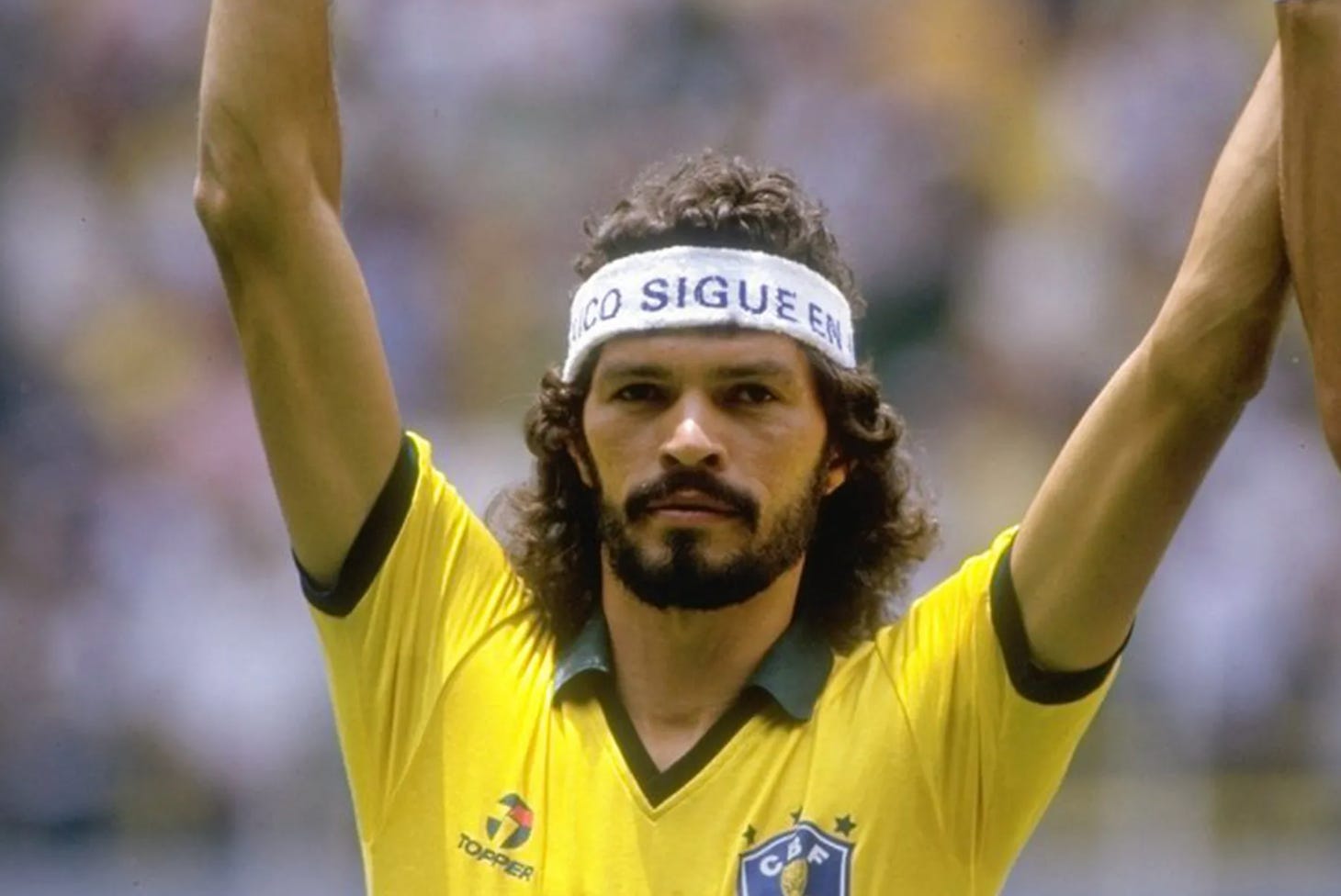
He returned to a Brazil that had not yet changed. The dictatorship lingered. Football returned to being a toy for the wealthy, a pacifier for the poor. And though he would never again reach the heights of 1982, Sócrates had already written himself into history, not for what he won, but for what he tried to give.
A football club had imagined a nation.
Possibly it all began with a man who didn’t want to be told where to sleep.
Definitely, it continued with courage.
He knew both the worlds of privilege and poverty.
But he only ever fought for one.
Cheers,
Will
Note: if you are looking for an in-depth read of Socrates’ life I cannot recommend highly enough the wonderful book by Andrew Downie, Doctor Socrates.
If you enjoyed this please consider subscribing to The Art of Football.
Sharing it with a coach, a player, or a fan supports our writing and we’d really appreciate it too ;)
Your thoughts are always welcome so please leave a comment or hit the like button to keep the conversation going.